
For a better understanding of using the BVMS Enterprise System, we encourage you to join our free online Training from KEENFINITY Academy!
A BVMS Enterprise System is used to enable a user of an Operator Client to simultaneously access multiple Management Servers (subsystems).
Also, the clients connected to an Enterprise Server have:
-
full access to all cameras and recordings from the subsystems.
-
full real time awareness of events and alarms of all subsystems.
Prerequisites:
For using an Enterprise System, you need valid licenses.
-
Each subsystem connected to the EMS needs a Subsystem Expansion license in the EMS
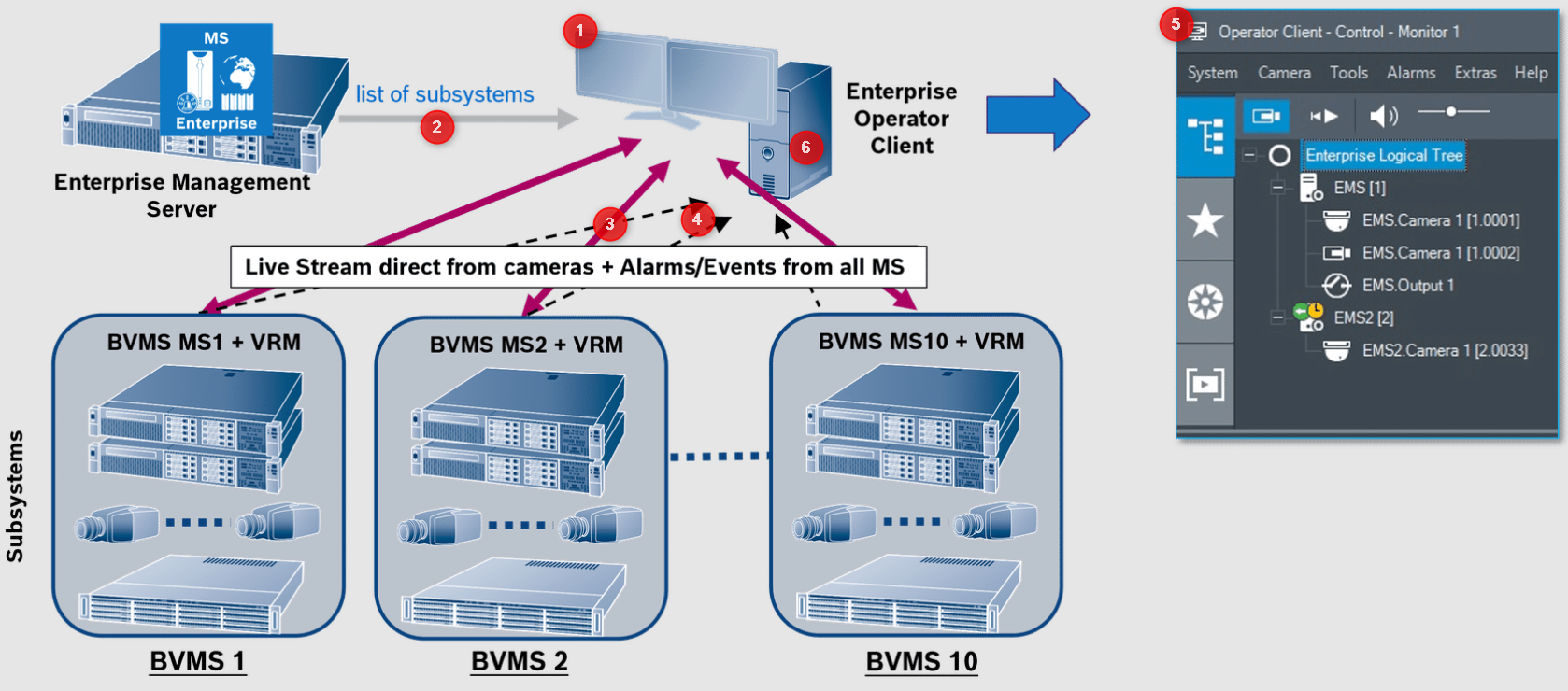
Overview of an enterprise system:
-
Enterprise Operator Client connects to the Enterprise Management Server.
-
Enterprise Management Server provides a list with the subsystems to the Enterprise Operator Client.
-
. Enterprise Operator Client connects to the subsystems and downloads the configuration of the subsystems.
-
Afterwards it shows the device list of each single subsystem.
-
The Enterprise Operator Client provides access to all cameras and recordings of the subsystems – dependent on the user permissions.
-
Live pictures are streamed directly from the cameras to the Enterprise Operator Client providing low latency video.
-
Enterprise Operator Client receives all the events and alarms from all the subsystems.
-
After first connection the list of subsystems is stored in the Enterprise Operator Client.
Resilience: The Enterprise Operator Client can even connect to the subsystems, in the case the Enterprise Management Server should be unavailable.
Step-by-step guide
In order to create an Enterprise System on an Enterprise Management Server (EMS) and on multiple Management Server computers, the following tasks should be performed:
-
Create an Enterprise Account on each subsystem
-
Add each MS (subsystem) to the Enterprise Server List (Network Address)
-
Create an Enterprise User Group (EUG) on EMS
-
Create a new “human” user for the EUG
1. Create an Enterprise Account on each subsystem
-
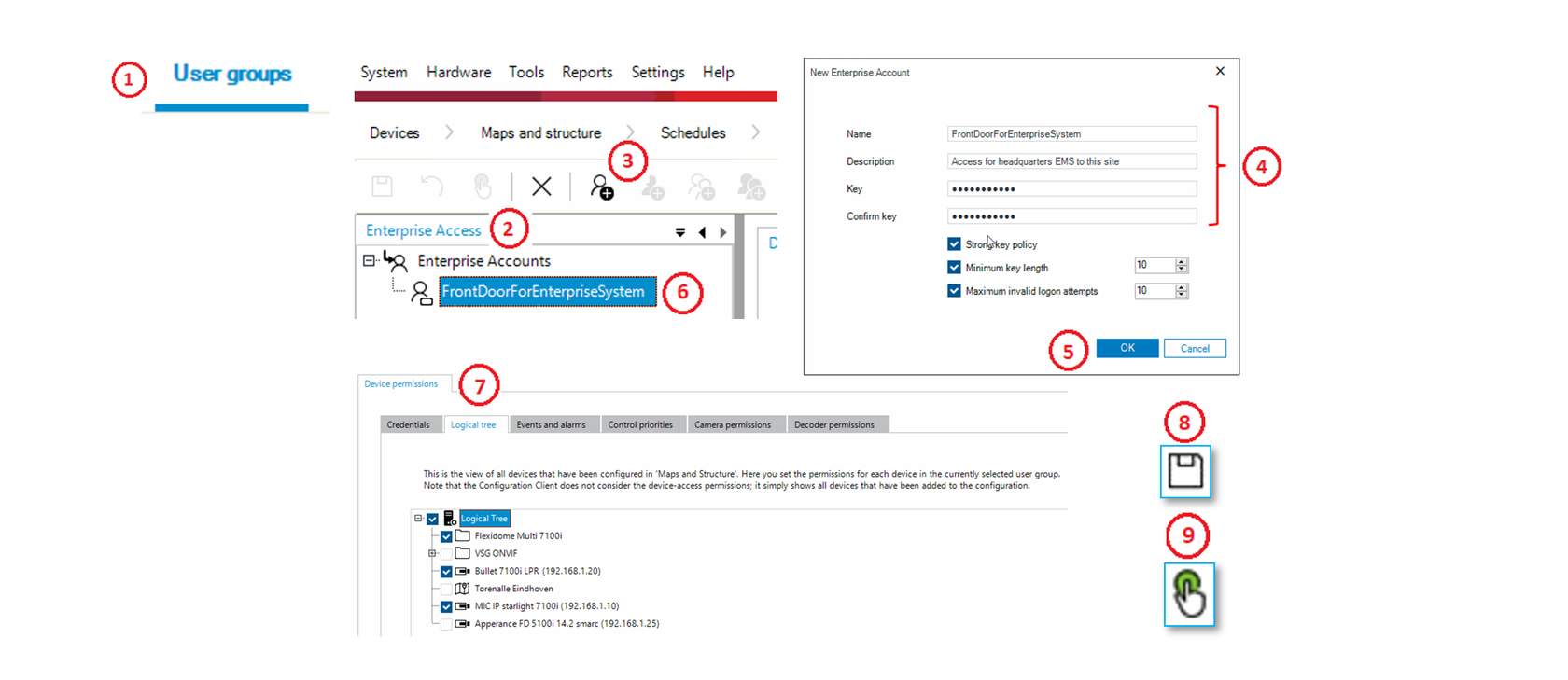
In the Configuration Client subsystem, go to the User Groups page.
-
Click on the Enterprise Access tab.
-
Click the Add new user group/account icon.
-
A New Enterprise Account dialog box will appear. Enter an account name and key (password). This is a machine account (not used by a person).
-
Click OK.
-
Click on the newly created Enterprise account.
-
Define the Device Permissions for the enterprise system login (EA).
-
Click the Save icon.
-
Click the Activate icon.
2. Add each MS (subsystem) to the Enterprise Server List (Network Address)
-
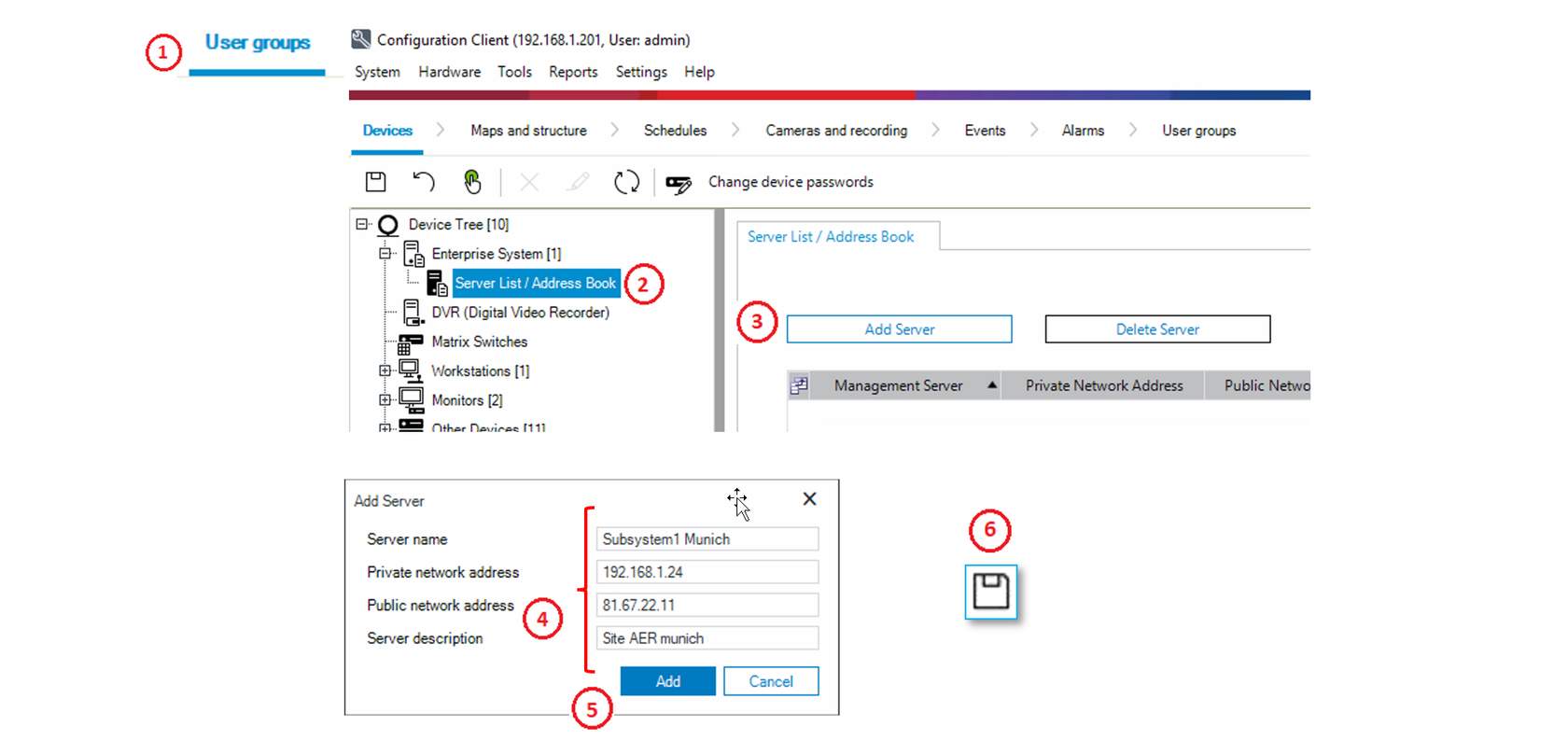
On the Enterprise Management Server, click on the Devices page.
-
Select Device Tree -> Enterprise System ->Server List
-
Click on the Add Server button.
-
An Add Server dialog box appears, Provide a Server Name and Private or Public IP address of the MS subsystem.
-
Click the Add button.
-
Click the Save icon.
3. Create an Enterprise User Group (EUG) on EMS
-
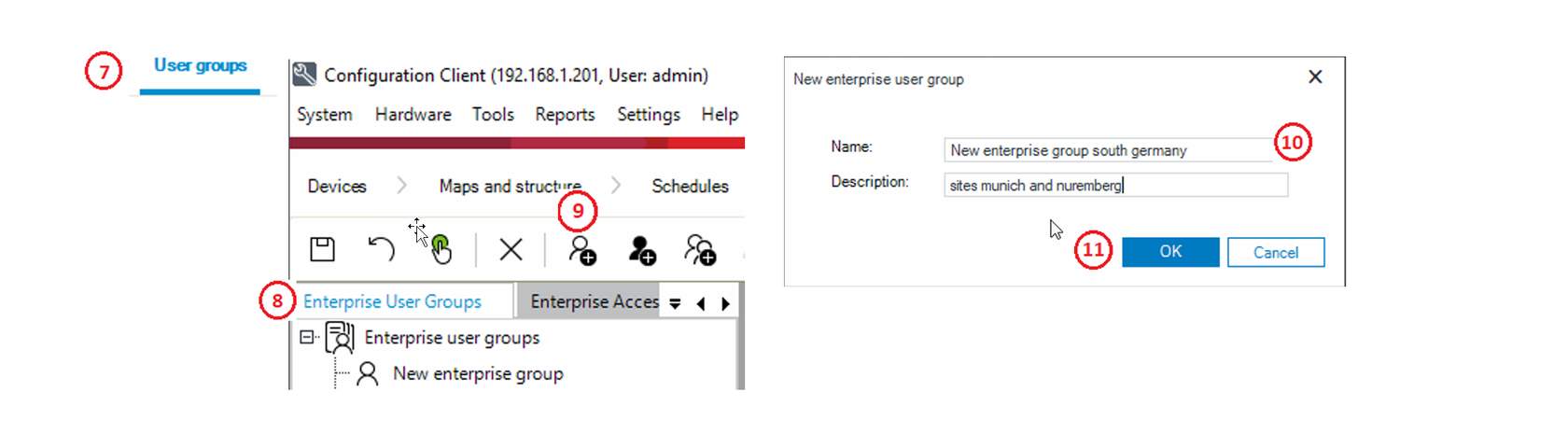
Click on the User Groups page.
-
Click on the Enterprise User Groups (EUG) tab.
-
Click on the Add new user group/account icon
-
A New Enterprise User Groups dialog box appears. Provide a name for the Enterprise User Group.
-
Click the OK button.
-
Select the newly created Enterprise User Group.
-
On the right-side, select Server Access.
-
Enable the Access checkbox for the MS.
-
Provide the Enterprise Account name which was created in the local MS of each Subsystem.
-
Provide the Enterprise Account Key (password) which was created in the local MS of each Subsystem.
4. Create a new “human” user for the EUG
-
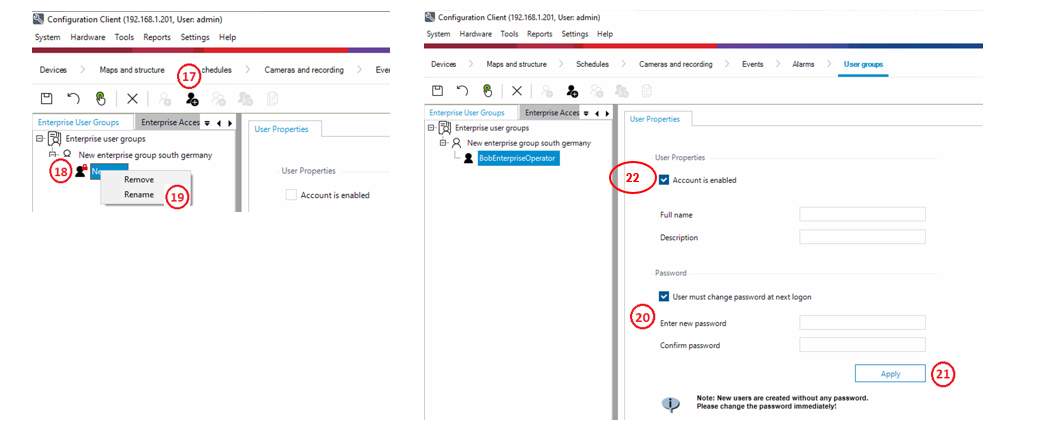
Click the 17 Add new user icon
-
Click on the New User.
-
Right-click and select Rename. Provide a new user name (e.g. BobEUG1 or JohnEUG2 or FranzEUG3)
-
Provide a password. Just remember it.
-
Click on Apply icon.
-
Enable the account
-
Click on the Save icon. Click on the Activate icon.