
Question
What is the difference between video coding H264 and H265 (Bosch cameras)?
Answer
H.264 (also known as AVC, Advanced Video Coding) and H.265 (also known as HEVC, High Efficiency Video Coding) are both video compression standards, but they differ significantly in terms of compression efficiency, quality, and computational requirements
H.265 provides better compression efficiency, it requires more processing power to encode and decode video, meaning that it may not be the best choice for older or less powerful devices. H. 264, on the other hand, requires less processing power, making it more efficient on older or less powerful devices.
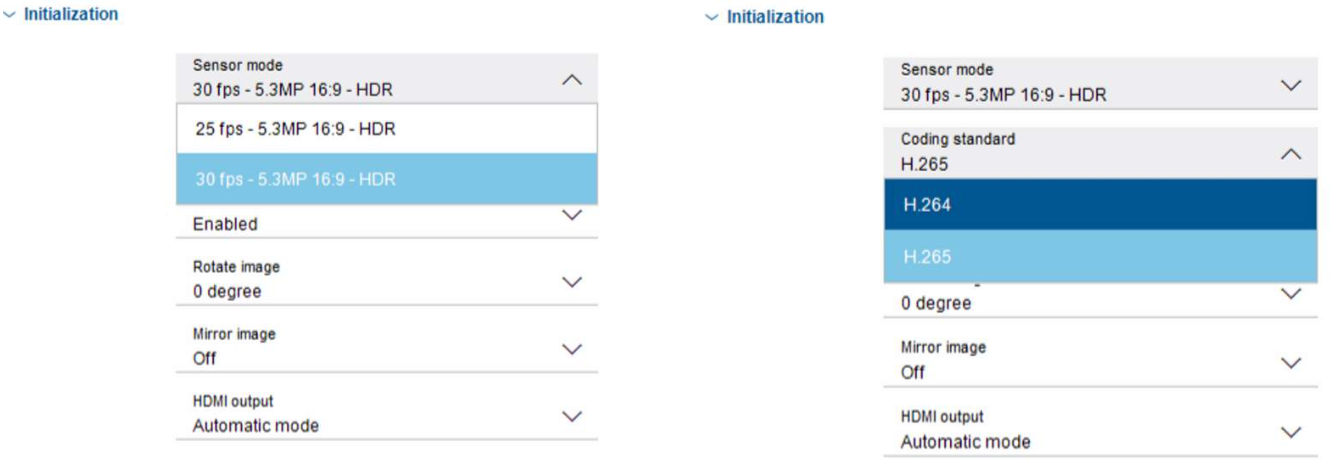
Sensor Mode can be changed depending on the camera.
Other devices can also be set to H.265 or H.264 encoding!
H.264:
-
H.264 offers good compression efficiency, reducing the size of video files while maintaining quality. It has been the industry standard for many years and is widely used in streaming, and other applications.
-
H.264 / MPEG-4-Part 10 / MPEG-4-AVC (ISO/IEC 14496-10) are common names for the same video compression standard.
H.265:
-
The successor of H.264 is H.265 (HEVC)
-
H.265 offers approximately 50% better compression efficiency compared to H.264. This means that videos encoded with H.265 can achieve the same quality as H.264 but at half the file size, or higher quality at the same file size. This efficiency is particularly beneficial for 4K and higher resolutions.
-
All new Bosch cameras support also H.265. The “i” at the end of the product name is an indicator for H.265 support. (e.g., FLEXIDOME IP 5100i)
-
Workstations need to have more performance for decoding (more complex).
Difference between H.264 and H.265 (HEVC):
|
|
H.264 |
H.265 (HEVC) |
|
Block size
|
16 x 16 pixels |
64 x 64 pixels |
|
Prediction modes
|
9 prediction modes |
35 prediction modes |
|
Required decoding computing power |
|
|
Explanation:
H265 is more efficient than H264, but why? There are 2 examples here to show you the difference.
-
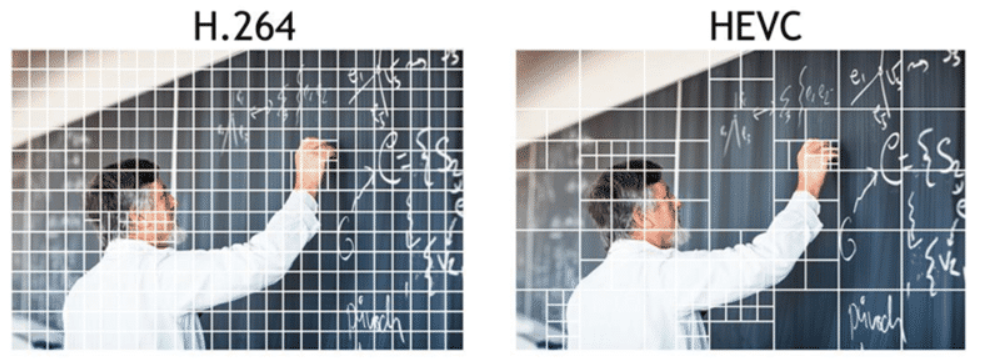
Let’s start with block sizes. The I-frames are divided into blocks by the codec (H264 or H265). The biggest block size in H264 is 16 by 16 pixels. The H264 decides from the movement of the fingers here what block size to encode, it can be small block sizes but will not be bigger than 16 by 16 pixels. The blocks are required to reference the I-frame to the P-frame. The P-frame will show the information that, in this example, block number 1 (top left corner) is empty because there is no movement, block number 2 and so on.
But if there was movement in any other area of the image the blocks size is dynamically determined by the encoding algorithm and the difference to the previous frame is described.
In H265, the blocks are bigger. They can be up to 64 by 64 pixels. That saves bandwidth. For areas without any change the block size can be bigger, so less data will be sent in total.
-
Another reason is the prediction mode needed to extrapolate or continue directions. In H264, there were 9 prediction modes available. The codec tries to predict the movement of the object using a direction, H264 will use one of 9 prediction modes to predict where the hand is moving and it creates the encoding from that prediction. H265 is more powerful in the accuracy predicting which direction the object is moving. It has 35 prediction modes that give H265 better accuracy and higher efficiency in encoding, but that also requires a powerful hardware chip in the camera. That is possible with our new camera generation and newer platforms, they have a hardware chip that is used for H265 encoding only, so the performance is not an issue. On the other hand, the decoding is done on the operator client and on the workstation hardware, with the graphic card, so a more powerful graphic card is needed to decode H265.
