
Question
What is E-series iSCSI multipathing and storage array multipathing?
Answer
Multipathing is a feature of dual controller devices and is implemented in the system in 2 ways:
-
iSCSI multipathing
-
SAN multipathing
E-Series iSCSI multipathing:
On each controller in a dual controller device, there are 2 Ethernet connectors.
The iSCSI multipathing feature is implemented on the application level and it is implemented using the cameras and VRM to create a high redundancy.
The dual controller has 2 options to connect the iSCSI devices to the controller:
-
The default connection is through two RJ45 ports
-
The alternative option is through two available optical ports
Which one is chosen depends on the connection options in the rest of the network, both offer 10Gbps bandwidth.
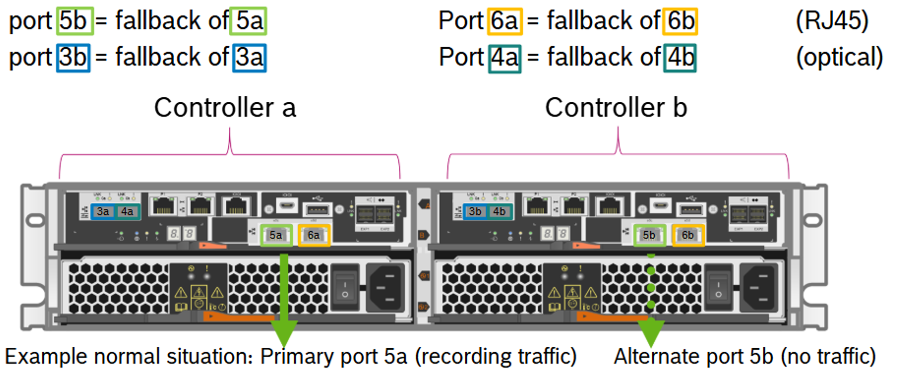
Multipathing is enabled by default on dual controller system à No additional configuration required.
In the diagram you can see that we have 2 Ethernet ports on each controller:
· Port 5a and 6a on the left controller a
· Port 5a and 6a on the left controller b
In the multipathing setup, ports 5a and 5b are combined into a pair. When the VRM starts recording, it transmits the IP addressed of these ports to the camera, and the camera will start recording to the IP addresses of controller a.
When for some reason controller a becomes unavailable, the camera already has controller b’s IP address, so it knows an alternative route to the same iSCSI device.
The camera will then use port 5b as a fall-back and continuous recording is ensured, as the camera is aware of an alternative way to reach the iSCSI device.
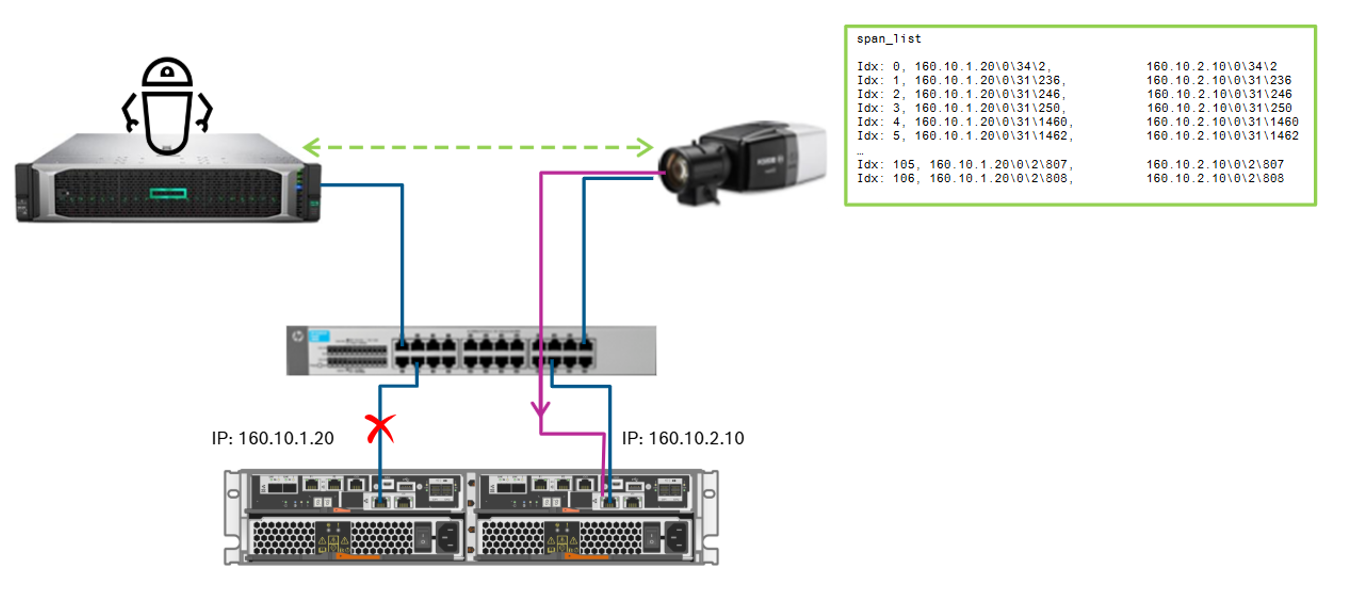
iSCSI multipathing explained:
-
The camera wants to start recording and contacts VRM
-
VRM knows it has a recording device with multipathing available, so it sends the camera a blocklist which contains the main IP address as well as the fall-back IP address
-
The camera then starts recording using the main IP address
-
If the main IP address becomes unreachable (for whatever reason, could be network-related or device-related), the camera will know that it has a fall-back address
-
It will look up this address and will automatically start recording on this address. No recording gaps will occur
-
The dual controller will make sure that the video is still stored on the same blocks, in the same storage device
Storage Array Multipathing:
Storage Array Multipathing helps the system to continue to store video data, without interruption when a physical storage network path fails. Multipathing provides a redundant path for the data cables connecting the controllers to the expansion units.
For example: you can connect two expansion units to the redundant controller pair in a storage array, with different data cables for each controller. If one expansion unit, one data cable, one controller fails, the multipath option automatically reroutes input and output to the operational path.
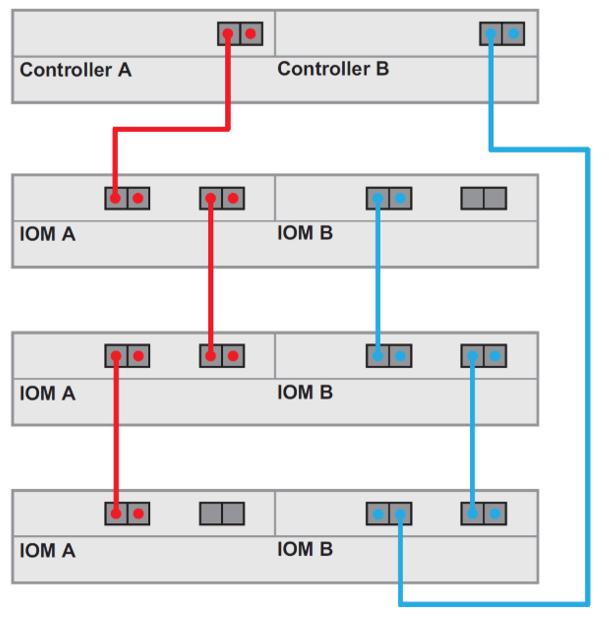
In the diagram you can see an example of the wiring required to make multipathing work, the actual management of this system is done in the controller unit.
Storage Array Multipathing features are as follows:
· They automatically identify redundant Input and Output paths.
· They automatically reroute I/O to an alternate controller when a controller fails or all of the data paths to a controller fail (failover).
· They check the state of known paths to the storage array.
· They provide status information on the controller and the bus.
· They provide load balancing between available paths.
